
BCW 31: Shein
Invisible Man Who Dressed a Billion
Welcome to the 19 of you who joined Business Case Weekly this week.
I’m sorry I missed last week. I had a really bad headache and wasn’t able to look at my laptop screen.
sneak peak: How Shein's algorithmic fashion machine broke
A case study in algorithmic retail, geopolitical arbitrage, and the cost of opacity
Most fast-fashion stories start with a designer. Shein’s starts with a search engine optimizer.
Xu Yangtian built the world’s largest online fashion retailer without giving a single public interview for over a decade. He turned a wedding-dress dropshipping operation into a $38 billion revenue machine by treating clothes not as creative expression but as data packets, testing demand with 100-unit batches before committing capital. Every incumbent he surpassed, from H&M to Zara, saw fashion as a design problem. Xu saw it as an information problem. That framing produced the fastest-growing consumer company in modern history, and a set of collateral consequences that now threaten to consume it.
An SEO Specialist in Nanjing, 2008–2012
Xu Yangtian was born in 1984 to a working-class family in Zibo, an industrial city in China’s Shandong province. By one account, meat at meals was a rarity [1]. He studied international business at a provincial university, graduating in 2007, and moved to Nanjing to work at a marketing consultancy where he specialized in search engine optimization. The SEO work gave him a specific insight that most of his peers in the fashion industry would never possess. He understood, at a granular level, what people were searching for online and where the gap between search intent and available supply was widest.
In 2008, Xu co-founded a cross-border e-commerce company, Nanjing Dianwei Information Technology, with two partners, Wang Xiaohu and Li Peng [2]. The trio sold various products to international buyers, but Xu noticed that wedding dresses generated disproportionate demand from Western consumers. Chinese manufacturers could produce them for a fraction of what American or European retailers charged. The only barrier was currency conversion and trust.
By 2011, Xu had registered the domain SheInside.com and launched an online wedding dress store [3]. What happened next is disputed. According to both Wired and The Guardian, citing his former partners, Xu disappeared overnight, taking control of the company’s PayPal accounts and severing contact with Wang and Li [4]. Li Peng later said Xu “kicked us out of the game” [5]. Shein has rejected this characterization, and Xu has threatened legal action over the claims. But the partnership was over. Xu was alone with a functioning e-commerce business and the skills to drive traffic to it.
SheInside operated as a pure dropshipper. Xu designed nothing and manufactured nothing. He sourced garments from Guangzhou’s wholesale clothing market and shipped them directly to overseas buyers, using his SEO expertise to capture search demand at a fraction of the customer acquisition cost his competitors paid. By 2013, the company had more than 50 employees [6].
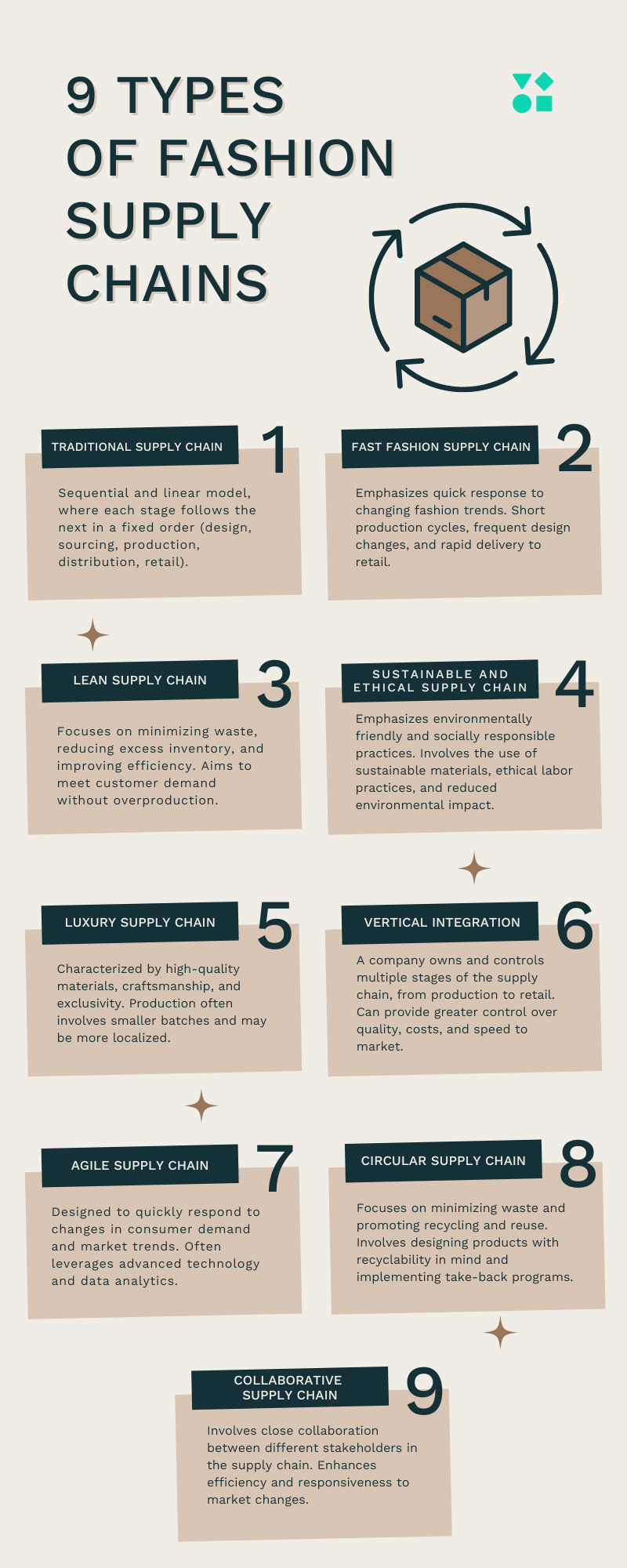
If you were a venture investor in 2012, would you have funded a Chinese wedding-dress dropshipper run by a first-time founder with no fashion experience and a disputed co-founder split? What signal would you need to see beyond raw revenue growth?
From Wedding Gowns to Fast Fashion, 2012–2016
In 2012, Shein received a $5 million investment that allowed Xu to relocate operations to Guangzhou, the epicenter of China’s garment manufacturing [7]. The move was decisive. Nanjing had internet talent. Guangzhou had factories. What Xu was building required both.
We’re committed to more transparency. We want people to see all the different places that we make things from.
Donald Tang, Executive Chairman, Interview with TIME, July 2023 [8]
The statement came years later, but it reveals the logic Xu was already applying in 2012. The closer Shein sat to its manufacturers, the faster it could respond to demand signals. While traditional fashion brands planned collections six to nine months ahead, Xu wanted to compress the cycle to weeks.
In June 2015, SheInside rebranded as Shein, with the slogan “She In, Shine Out” [9]. The name change was more than cosmetic. It marked the end of the wedding-dress era and the beginning of Shein’s transformation into a comprehensive fast-fashion platform. A Series B round of approximately $45 million funded the expansion [10].
By 2016, Xu had assembled a team of 800 designers and prototype makers producing Shein-branded clothing [11]. The company was no longer a dropshipper. It was becoming something entirely new: a technology company that happened to sell clothes. Xu began building the software infrastructure that would connect Shein’s design team directly to its supplier network, creating a feedback loop between consumer demand data and factory floor production.
We have a lot more to do on the journey of total transparency. So we must do more: invite reporters to see the factories, whatever questions they have, we’ll answer.
Donald Tang, Interview with TIME, July 2023 [8]
The early supply chain was rough. Shein excluded vendors that provided low-quality items or photos, gradually tightening quality controls [12]. But the core mechanism was already in place. Xu had grasped something that would take the rest of the industry years to understand: in an era of infinite online shelf space, the constraint was not how many styles you could design but how quickly you could test whether anyone wanted them.
You are a product manager at Zara in 2015. Shein is still a small Chinese e-commerce site selling cheap clothes. Your boss asks you to evaluate the competitive threat. Based on Zara’s own fast-fashion model, which typically takes two to four weeks from design to shelf, what would you flag as dangerous about Shein’s approach?
The Algorithm Wears Prada, 2016–2020
The machinery that turned Shein from a mid-tier Chinese e-commerce player into a global juggernaut was a system called LATR: Large-scale Automated Test and Reorder [13]. The concept was brutally simple. Instead of betting on which designs would sell, Shein produced micro-batches of 100 to 200 pieces for each new style and released them to its app. Algorithms monitored customer engagement, sales velocity, and social media mentions in real time. Winners were scaled up. Losers were killed before significant resources were wasted [14].
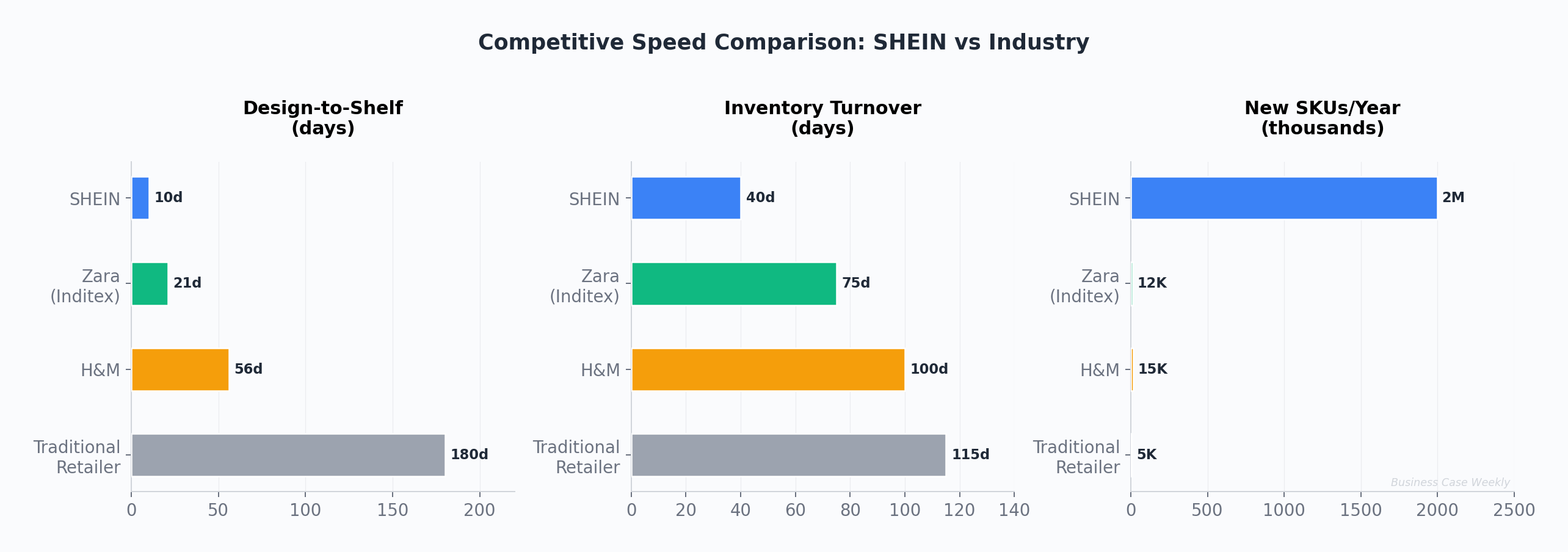
The results were staggering. Shein could launch between 2,000 and 10,000 new items daily, compared to Zara’s roughly 4,500 per year [15]. Its inventory turnover sat at approximately 40 days, against an industry average of 108 to 121 days [16]. Unsold inventory hovered in the low single digits, while traditional retailers routinely carried 25% to 30% [17].
We’re not fast fashion. We’re fashion on demand.
Donald Tang, CNBC interview, January 2025 [18]
The distinction mattered. Traditional fast fashion copied runway trends and produced them cheaply. Shein’s LATR system did something different. It let consumers vote with their wallets before production scaled. The design-to-shelf cycle compressed to seven to fourteen days, with some items moving from concept to live listing in as little as three days [19]. Xu had essentially built an A/B testing engine for physical products.
To make this work, Shein built deep relationships with 300 to 400 core factories clustered around Guangzhou [20]. These suppliers were not passive vendors. They were plugged into Shein’s proprietary digital platform, receiving live order data, production schedules, and reorder signals tied directly to consumer behavior. A digital bidding system automated order allocation: when an order was placed, Shein’s algorithm recommended it to the most suitable workshop, and suppliers accepted online [21].
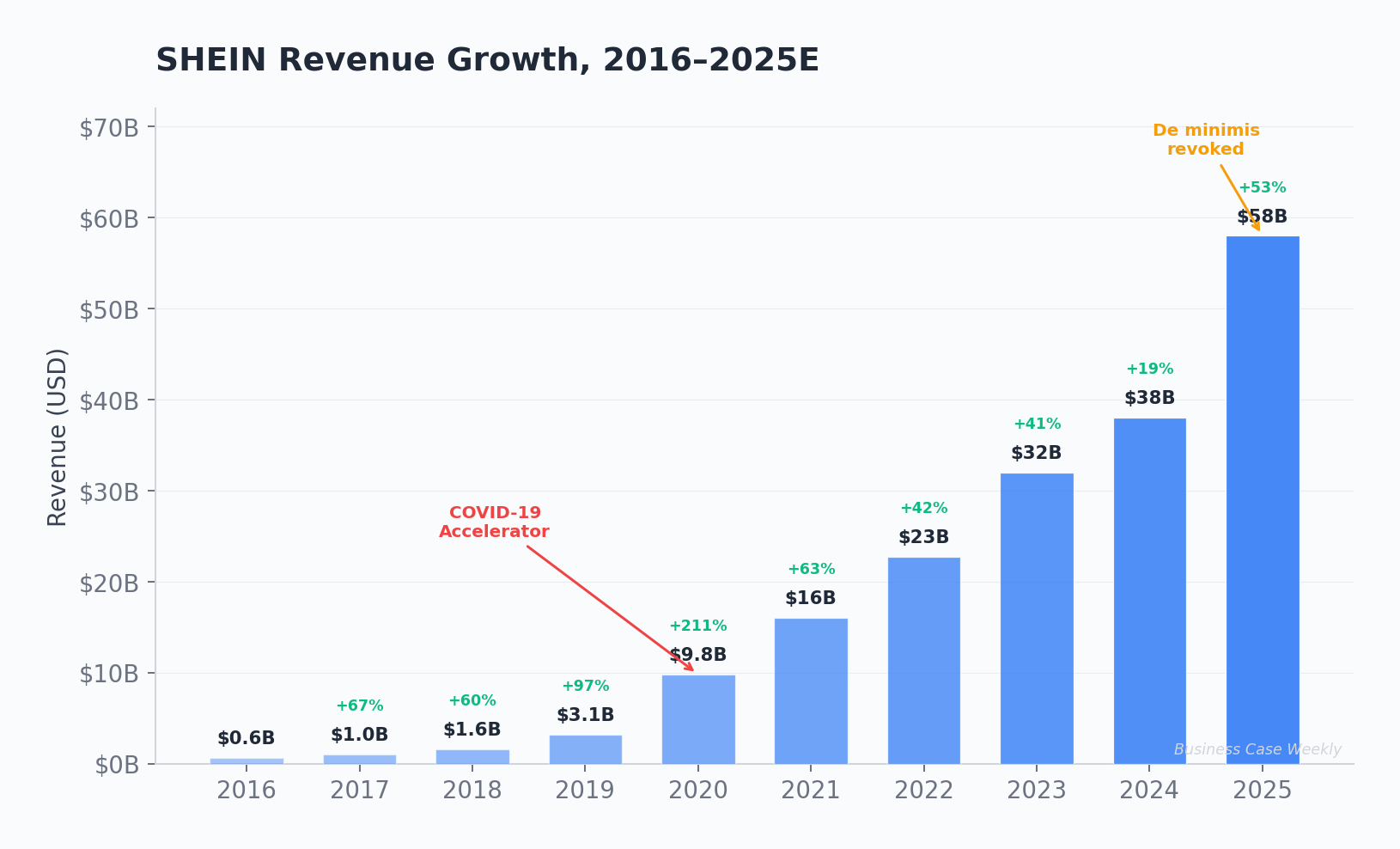
The pandemic accelerated everything. As brick-and-mortar retail shut down globally in 2020, Shein’s purely online model caught an enormous tailwind. Revenue reportedly tripled from $3.15 billion in 2019 to approximately $10 billion in 2020, marking the seventh consecutive year of more than 100% sales growth [22]. Shein became the world’s largest online-only fashion company.
The company was also an early adopter of TikTok as a promotional channel. “Shein haul” videos, in which consumers showed off enormous bags of ultra-cheap purchases on camera, became a social media genre unto themselves. By 2021, Shein was the most downloaded shopping app worldwide [23].
In a survey that we have done recently with our customers, 87 percent of the respondents have changed to more affordable options after noticing the cost of living has increased significantly.
Donald Tang, WWD Webinar, June 2023 [24]

You are running supply chain operations at H&M in 2020. Shein has just grown 200% in a single year, is adding 6,000 SKUs daily, and is turning inventory in 40 days. Your team turns inventory in 120 days. What structural changes would you propose, and which would your board actually approve?
The $100 Billion Mirage, 2020–2024
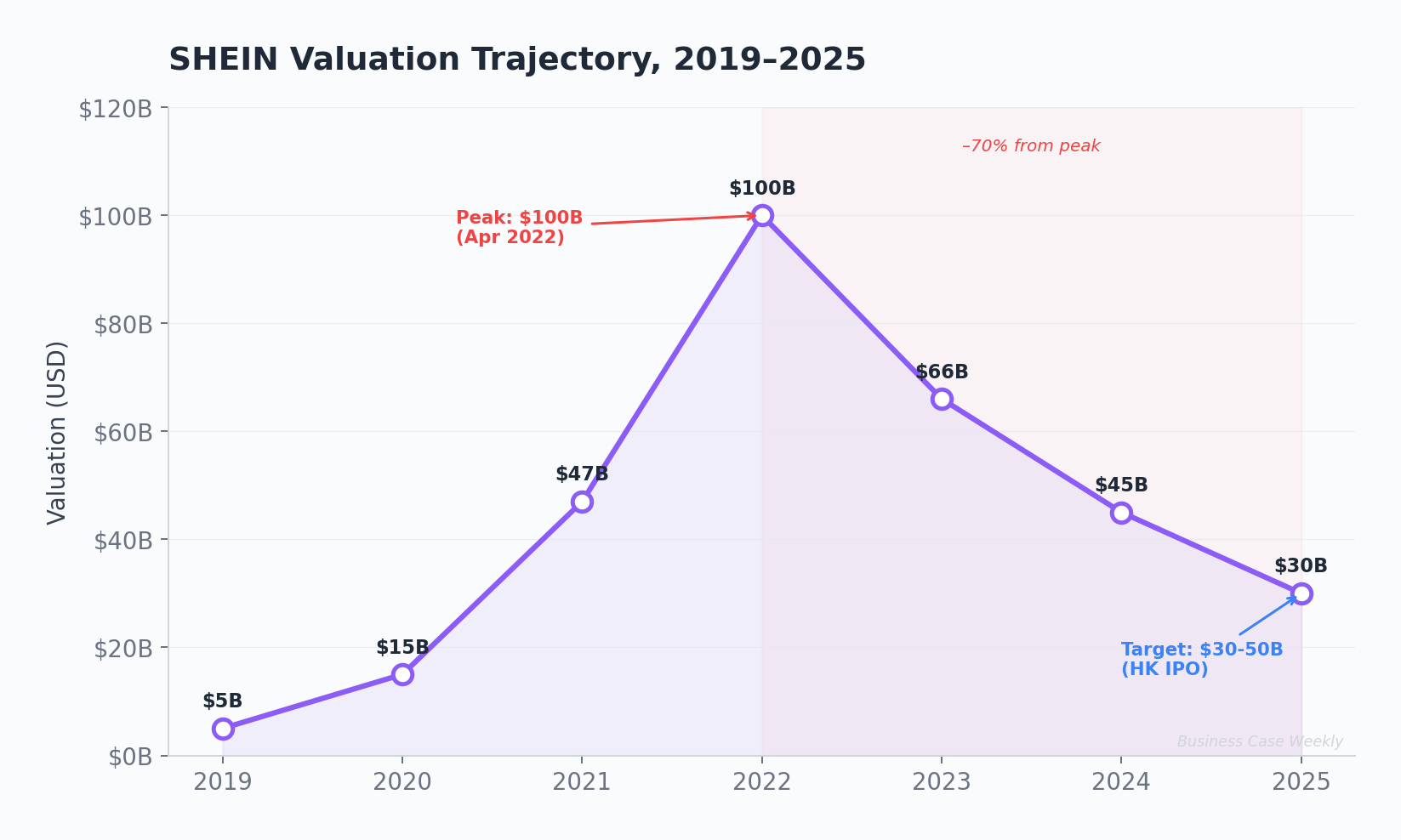
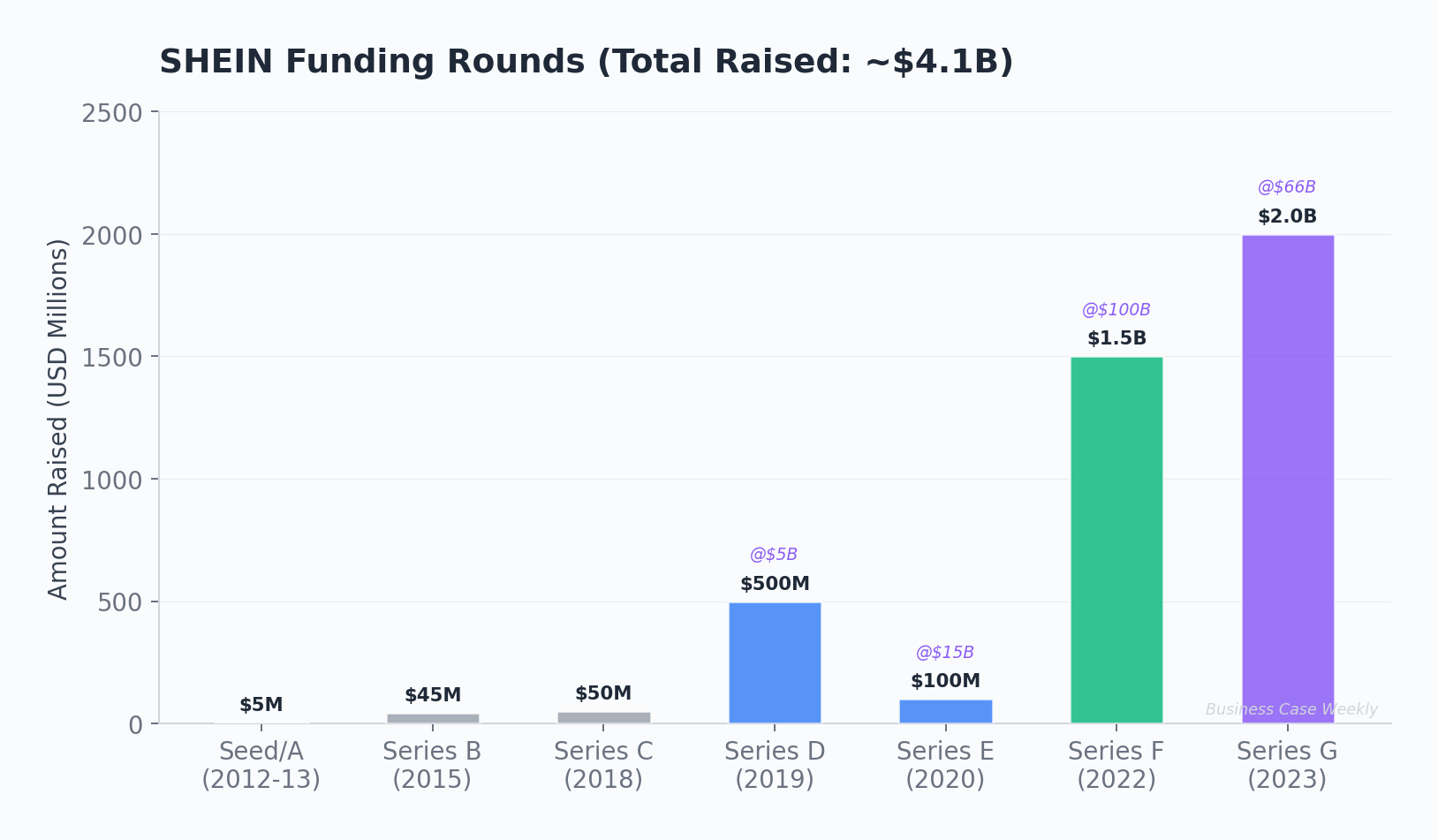
By 2022, Shein’s private valuation peaked at $100 billion, placing it ahead of H&M and Inditex combined in market terms [25]. Revenue hit an estimated $22.7 billion that year [26]. The company had raised over $4 billion in total venture capital, with backers including HongShan (formerly Sequoia China), General Atlantic, Mubadala, Tiger Global, and Brookfield [27]. Xu Yangtian himself was reportedly worth over $10 billion.
But the peak valuation masked fractures that were already spreading beneath the surface.
The first crack was competition. In September 2022, PDD Holdings launched Temu in the United States, using a similar playbook of ultra-low prices and direct shipping from China. Temu grew explosively, and by 2023 the two companies were engaged in mutual lawsuits, with Temu alleging anticompetitive behavior and Shein filing countersuits [28].
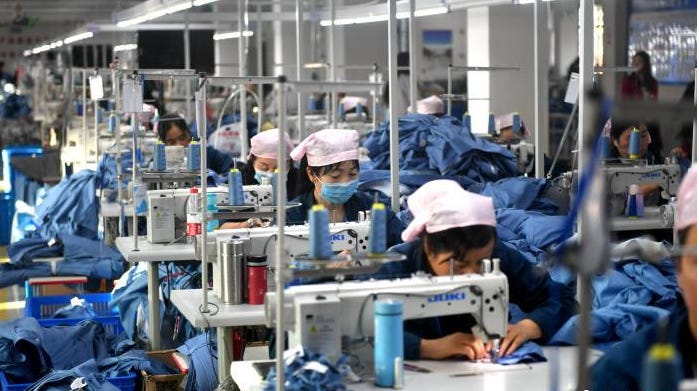
The second crack was reputational. A 2021 investigation by Swiss nonprofit Public Eye found employees at six Shein suppliers in Guangzhou working 75-hour weeks in breach of Chinese labor laws [29]. A Channel 4 documentary, Inside the Shein Machine, filmed factory workers pulling 17-hour shifts. In 2023, Shein organized an influencer trip to its factories that backfired spectacularly when the participating influencers were criticized for appearing to whitewash working conditions [30].
We’re committed to better working conditions. We have done quite a lot since last year. That’s not enough. We have to do a lot more to ensure that consumers are taken care of and that workers are taken care of.
Donald Tang, Interview with TIME, July 2023 [8]
The third crack was intellectual property. By July 2023, more than 50 IP infringement lawsuits were pending against Shein [31]. Three independent designers sued under the federal RICO Act, alleging that Shein’s systematic copying of their work constituted racketeering. One plaintiff, designer Krista Perry, described being contacted by Shein to contribute to a capsule collection after the company had already copied her work without permission [32]. A federal judge denied Shein’s motion to dismiss the RICO charges in late 2024 [33].
Shein’s business model is: if we get sued, we pay, and otherwise, we just keep doing this because it’s so profitable.
Brett Lewis, Internet law and IP attorney, Fortune, April 2024 [34]
The valuation declined. By 2023, it had fallen to $66 billion. A $2 billion fundraising round that year priced the company at that level [35]. By 2024, secondary market transactions placed the valuation at roughly $45 billion, less than half the 2022 peak [36].
If you sat on Shein’s board in late 2023, with the valuation falling, RICO lawsuits mounting, and Temu eating into your US market share, would you push for an IPO to give early investors liquidity, or delay to resolve the reputational liabilities first? What is the cost of each path?
A Listing Without a Home, 2023–2025
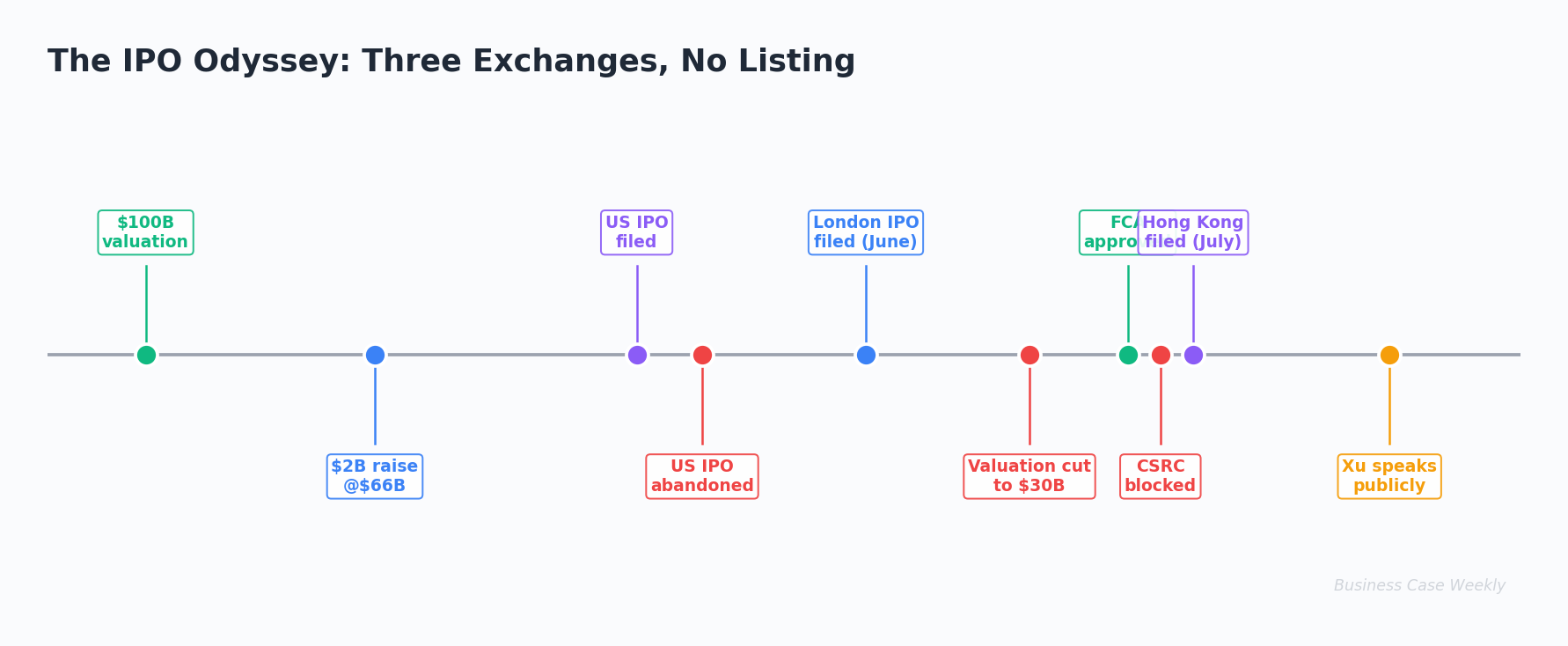
Shein’s IPO odyssey became one of the most tortured listing processes in recent corporate history. The company first pursued New York, the logical choice for a consumer tech giant. But US lawmakers pushed back hard. Concerns about supply chain ties to China’s Xinjiang region, where Western governments have alleged forced labor in cotton production, made a New York listing politically toxic [37].
In 2024, Shein pivoted to London. The London Stock Exchange, suffering its slowest decade for new listings, welcomed the prospect. Just 22 companies had listed on the UK exchange in 2024, raising a total of $2.48 billion [38]. A Shein float could have been the biggest London IPO in years.
But London brought its own problems. UK human rights group Stop Uyghur Genocide launched a legal campaign to block the listing. Fashion trade group the British Fashion Council raised concerns. The UK’s Independent Anti-Slavery Commissioner flagged Shein’s alleged human rights failings. Labour MP Liam Byrne, chair of the Business and Trade Committee, said he was “horrified” by Shein’s lack of transparency when the company appeared before investigators [39].
Britain’s Financial Conduct Authority approved Shein’s prospectus in March 2025 [40]. But the China Securities Regulatory Commission (CSRC) denied approval the following month. The sticking point was prosaic but unsolvable: UK and Chinese regulators could not agree on the language for the risk disclosure section regarding Shein’s operations in Xinjiang [41].
Shein’s dual-track IPO approach signals an aggressive effort to break a regulatory stalemate and preserve strategic flexibility.
Navina Rajan, Senior Analyst, PitchBook, July 2025 [42]
In July 2025, Shein filed confidentially for an IPO in Hong Kong, a move widely interpreted as pressure tactics against London regulators [43]. Goldman Sachs, Morgan Stanley, and JPMorgan were working on the listing [44]. But reports suggested the company might need to cut its valuation to $30 billion, less than a third of its 2022 peak, because of all of these issues [45].
The EU added another front. An investigation in May 2025 found Shein in breach of consumer protection laws, citing fake discounts, pressure selling, and misleading sustainability claims [46].
You are a managing director at Goldman Sachs, advising Shein on its IPO. The company has $12 billion in cash, no urgent need for capital, but its investors want liquidity. New York, London, and Hong Kong have all proven difficult. Would you recommend listing at a $30 billion valuation to get the deal done, or continue waiting for a better window?
The Tariff Wall and the Return to Guangzhou, 2025–Present
The biggest structural blow to Shein’s model came not from regulators or lawsuits but from trade policy. In April 2025, President Trump signed an executive order ending the de minimis exemption for shipments from China, effective May 2, 2025 [47]. The exemption had allowed packages valued under $800 to enter the US duty-free. Shein and Temu had relied on it to ship hundreds of millions of individual parcels to American consumers without paying tariffs. Overnight, those shipments faced duties of 120% or a flat fee of $100 per package [48].
The impact was immediate. Shein’s US daily active users fell 25% after the exemption ended. Weekly sales dropped by up to 23% year-over-year in June 2025 [49]. Both Shein and Temu raised prices for US consumers starting April 25, 2025 [50].
To maintain the quality of the products you cherish, we will be adjusting prices starting April 25, 2025.
Shein statement to US customers, April 2025 [51]
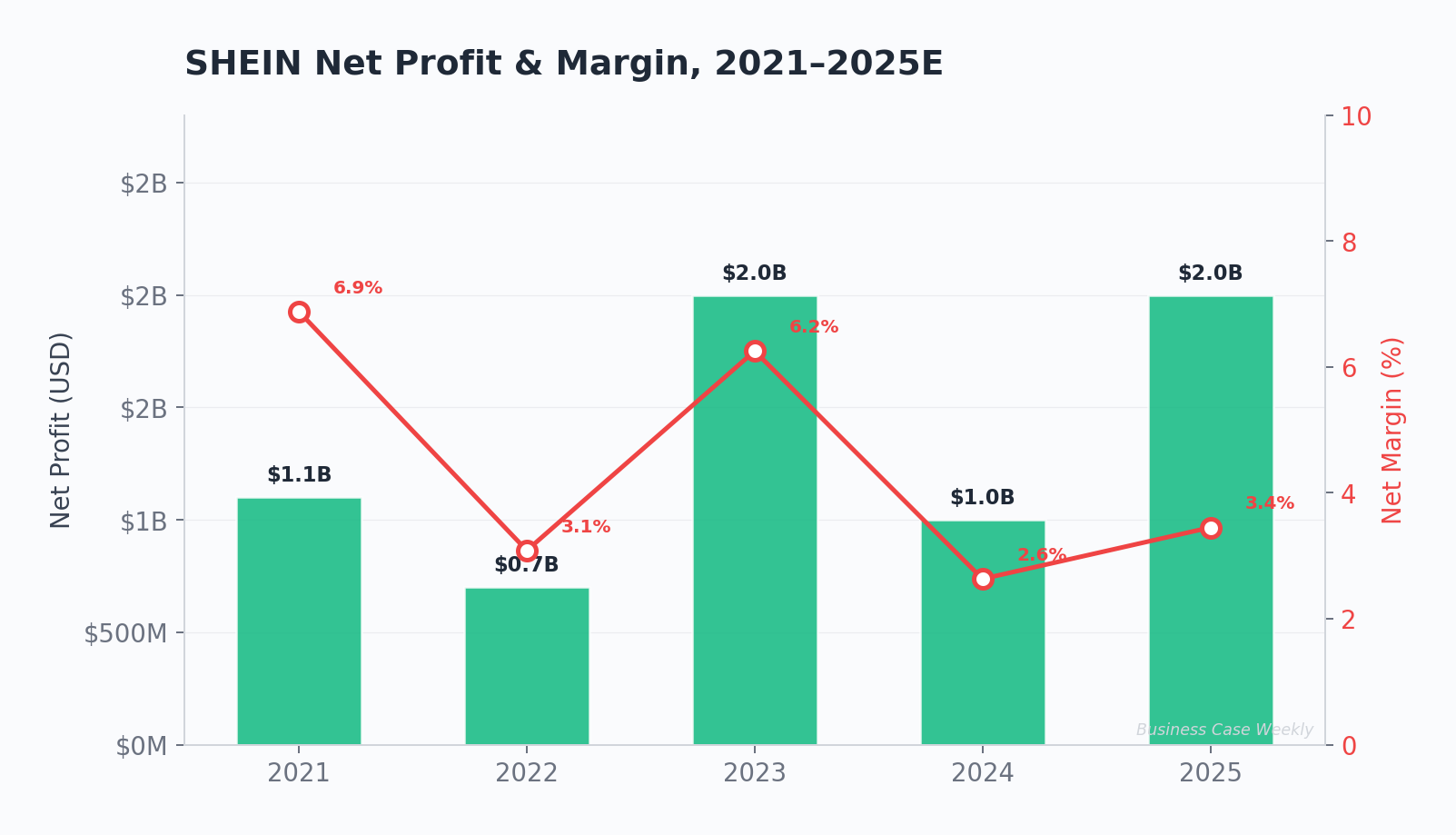
Net profit declined nearly 40% in 2024 to approximately $1 billion, despite a 19% increase in revenue to $38 billion [52]. The de minimis closure, combined with tariffs reaching as high as 54% on Chinese goods after a US-China trade deal in May 2025, fundamentally altered the unit economics that had powered Shein’s growth [53].
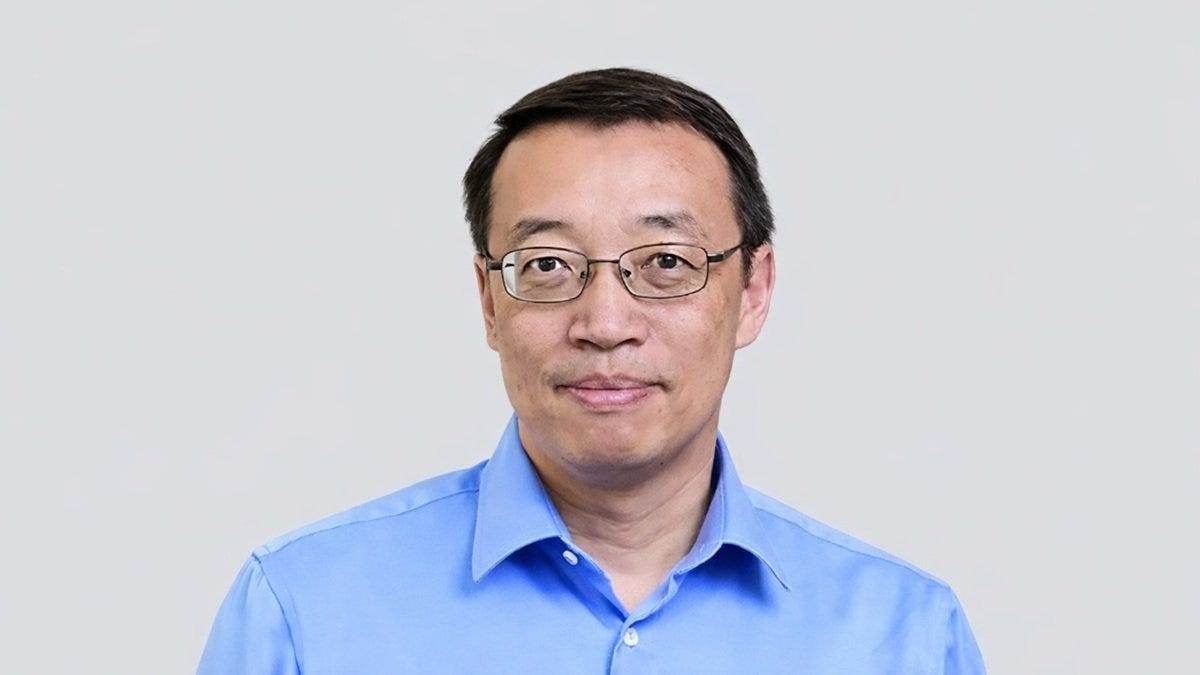
Then, in February 2026, the most secretive man in global fashion stepped out of the shadows. Xu Yangtian, who for over a decade had cultivated such extreme anonymity that employees joked they would not recognize him in an elevator, gave his first public speech [54]. At the Guangdong High-Quality Development Conference in Guangzhou, dressed in a black suit and burgundy tie, Xu announced an investment of 10 billion yuan (approximately $1.4 billion) in Guangdong’s supply chain infrastructure [55].
Shein will remain firmly rooted in Guangdong and build a world-class fashion industry cluster.
Xu Yangtian, Guangdong High-Quality Development Conference, February 2026 [56]
Every step of Shein’s growth is inseparable from the nourishment of this land.
Xu Yangtian, Guangdong High-Quality Development Conference, February 2026 [57]
The reversal was striking. For years, Shein had tried to distance itself from its Chinese origins, moving headquarters to Singapore, pursuing Western stock exchanges, even asking suppliers to shift production to Vietnam [58]. Now its founder was praising the Communist Party and provincial government on a livestreamed stage. The company works with nearly 10,000 suppliers in Guangzhou and supports more than 600,000 jobs across Guangdong [59].
The speech was widely read as a bid for Beijing’s goodwill ahead of a potential Hong Kong listing. As of April 2026, Shein’s IPO remains unresolved. The company may go public in Hong Kong in 2026, but the timing, venue, and valuation remain unclear [60].
Shein’s revenue still exceeded $38 billion in 2024 and it holds $12 billion in cash. But its US sales are declining, its valuation has dropped 70% from its peak, and its founder just pivoted from distancing the company from China to embracing Beijing publicly. Is this a tactical maneuver or a strategic retreat? What does it signal about Shein’s next five years?
Cross-Industry Parallels
Shein’s trajectory mirrors three distinct patterns from other industries.
The first parallel is with Amazon’s marketplace evolution. Like Amazon in the early 2010s, Shein has shifted from a vertically integrated model (designing and manufacturing its own products) to a hybrid platform that also hosts third-party sellers. In 2023, Shein launched a marketplace model with a 5–10% take rate, inviting external brands to sell on its platform [61]. Amazon made this transition in the mid-2000s and now derives more than 60% of unit sales from third-party sellers. The strategic logic is identical: reduce capital intensity, expand selection, and shift risk to sellers while capturing platform economics.
The second parallel is with Uber’s regulatory arbitrage. Both companies built massive user bases by operating in legal gray zones that incumbents could not or would not exploit. Uber used independent contractor classifications to avoid employment law; Shein used the de minimis exemption to avoid tariffs. In both cases, regulatory closure of the loophole forced fundamental business model adjustments. Uber eventually classified drivers differently in several jurisdictions and saw margins compress. Shein is raising prices and localizing supply chains, following the same playbook of grudging compliance when the arbitrage window closes.
The third parallel is with TikTok’s geopolitical positioning. Like TikTok’s parent ByteDance, Shein faces the structural problem of being a Chinese-founded company that derives most of its revenue from Western consumers. Both companies moved headquarters outside China (TikTok to Singapore, Shein to Singapore) and installed American-facing executives (TikTok’s CEO Shou Zi Chew, Shein’s executive chairman Donald Tang). Both found that corporate restructuring did not resolve the underlying geopolitical tension. The difference is that TikTok faces outright bans, while Shein faces tariffs and regulatory friction. The lesson from both cases is that corporate identity, once established, is nearly impossible to rebrand in a geopolitically charged environment.
Lessons
Shein’s entire competitive advantage rested on a single insight: that fashion retail is a demand-prediction problem, not a creative-expression problem. By treating every new style as a hypothesis to be tested with 100-unit batches rather than a creative bet to be produced in thousands, Shein eliminated the inventory risk that had been accepted as a cost of doing business for a century. The lesson is not that technology beats creativity. It is that the question you ask determines the system you build, and Shein asked a different question than every competitor.
The de minimis exemption was not a minor logistical convenience for Shein. It was the load-bearing wall of the entire business model. When it was removed in 2025, Shein’s US daily active users dropped 25% and weekly sales fell up to 23%. Building a multi-billion-dollar company on a tariff loophole is efficient right up until the moment it is not. Regulatory arbitrage compounds growth on the way up and compounds pain on the way down.
Xu Yangtian’s decade of silence was not merely personal preference. It was a competitive strategy that eventually became a liability. Opacity allowed Shein to grow without the scrutiny that public-facing CEOs attract, but it also meant the company had no credible voice when allegations of forced labor, IP theft, and environmental damage demanded a response. Donald Tang, hired in 2022 as executive vice chairman, was a retrospective fix for a problem that opacity had created. By the time Xu himself spoke publicly in February 2026, it was to an audience of Chinese officials, not Western regulators, and the message was about loyalty to Guangdong, not reform.
Shein’s IP lawsuits reveal a structural flaw in the LATR model. An algorithm that scours the internet for trending designs and produces them in 72 hours will, at sufficient scale, inevitably replicate copyrighted work. More than 50 IP lawsuits and a surviving RICO claim suggest this is not an accident but a systemic feature. The company’s response, that it takes all claims of infringement seriously, has not changed the underlying mechanics. When your business model requires producing 6,000 new items daily, the question is not whether you will infringe but how often and how expensively.
Shein’s IPO journey from New York to London to Hong Kong is a case study in what happens when a company’s corporate structure does not match its political reality. Shein moved to Singapore to appear global, but its supply chain remained in Guangdong, its founder retained Chinese citizenship, and its regulatory fate depended on Beijing’s approval. The result was a company that could not satisfy US concerns about Chinese ties, could not satisfy UK concerns about labor practices, and could not satisfy Chinese concerns about risk disclosures. A company caught between three regulatory systems, satisfying none, pays the price in time, valuation, and credibility.
Financial and Data Appendix
1. Revenue Trajectory
SHEIN’s revenue growth is among the most aggressive in consumer retail history. The company achieved seven consecutive years of 100%+ revenue growth from 2013 through 2020, a streak unmatched by any fashion retailer and rivaled only by a handful of technology companies.
2. The Valuation Collapse
SHEIN’s valuation trajectory is a case study in how private market enthusiasm can diverge from public market reality.
The revenue multiple compression tells the story of SHEIN’s institutional credibility erosion:
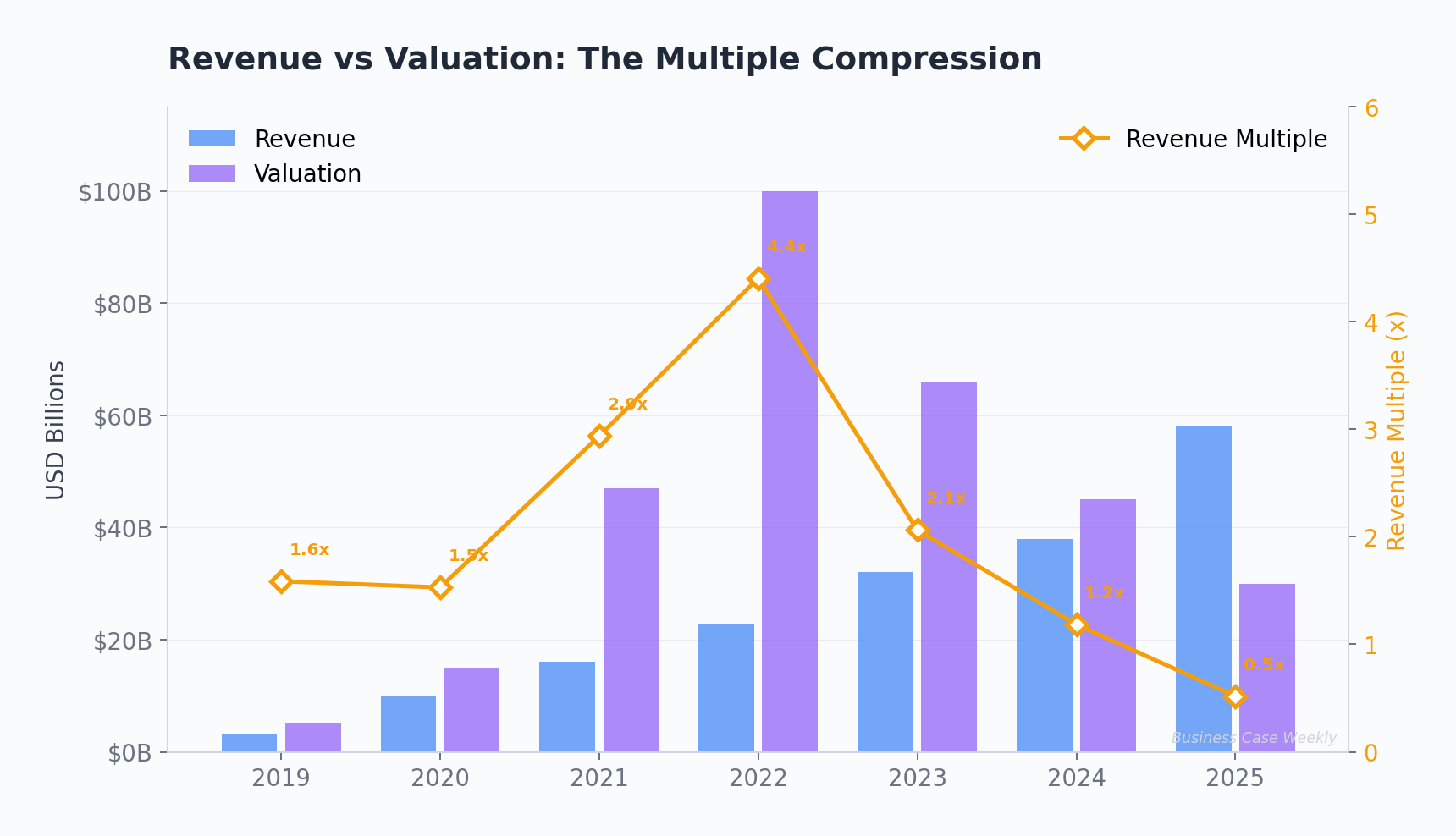
At peak ($100B, April 2022), SHEIN traded at 4.4x trailing revenue. By early 2025, the implied multiple on secondary markets had collapsed to 0.5x. Some Sacra estimates placed the August 2025 secondary market value as low as $10B, an implied 0.2x multiple on projected revenue.
For context, Inditex (Zara parent) trades at roughly 5-6x revenue. H&M trades at 1.2-1.5x. A 0.5x multiple for SHEIN implies the market is pricing in severe structural risk, not just a growth slowdown.
Why the Collapse
Four factors drove the valuation down:
IPO execution failure. Three exchanges, no listing. Every failed attempt increased the liquidity discount investors demand.
De minimis revocation. The trade provision that underpinned SHEIN’s US pricing advantage disappeared in 2025, permanently raising costs.
Regulatory pile-up. 40+ IP lawsuits, EU investigations, Texas AG probe, Uyghur cotton allegations.
Temu competition. PDD Holdings’ Temu launched in September 2022 and immediately eroded SHEIN’s US market share in ultra-cheap fashion.
3. Profitability
SHEIN achieved profitability earlier than most fast-growth e-commerce companies, but its margins are razor-thin.
4. Competitive Speed
SHEIN’s competitive moat is not price, brand, or design. It is speed and data feedback loops.
5. Gross Merchandise Value (GMV) and Platform Scale
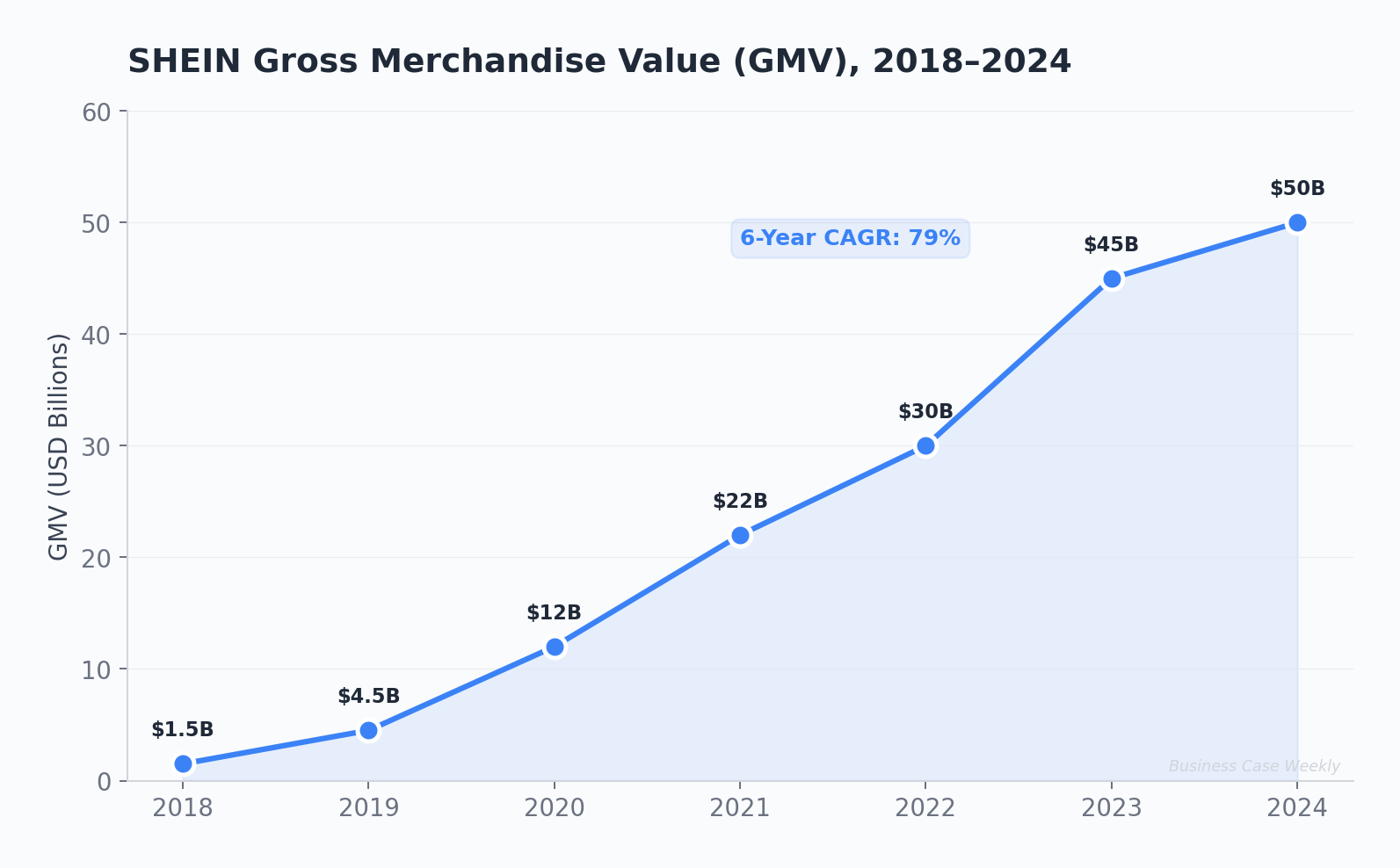
GMV vs Revenue
GMV measures total transaction value on SHEIN’s platform, including its growing third-party marketplace. Revenue measures what SHEIN itself recognizes.
The take rate varies because SHEIN operates two models:
1P (first-party): SHEIN-branded products manufactured through its supply chain. Net margin ~3.5% (2022).
3P (marketplace): Third-party sellers list on SHEIN. Take rate pitched at 5-10%.
SHEIN launched its marketplace (SHEIN Marketplace) in 2023 in the US and other regions, onboarding local sellers partly as a hedge against tariffs. Products sold by US-based sellers on SHEIN’s platform are not subject to China-origin tariffs.
6. The IPO Odyssey
7. De Minimis: The Trade Loophole That Built and Broke the Model
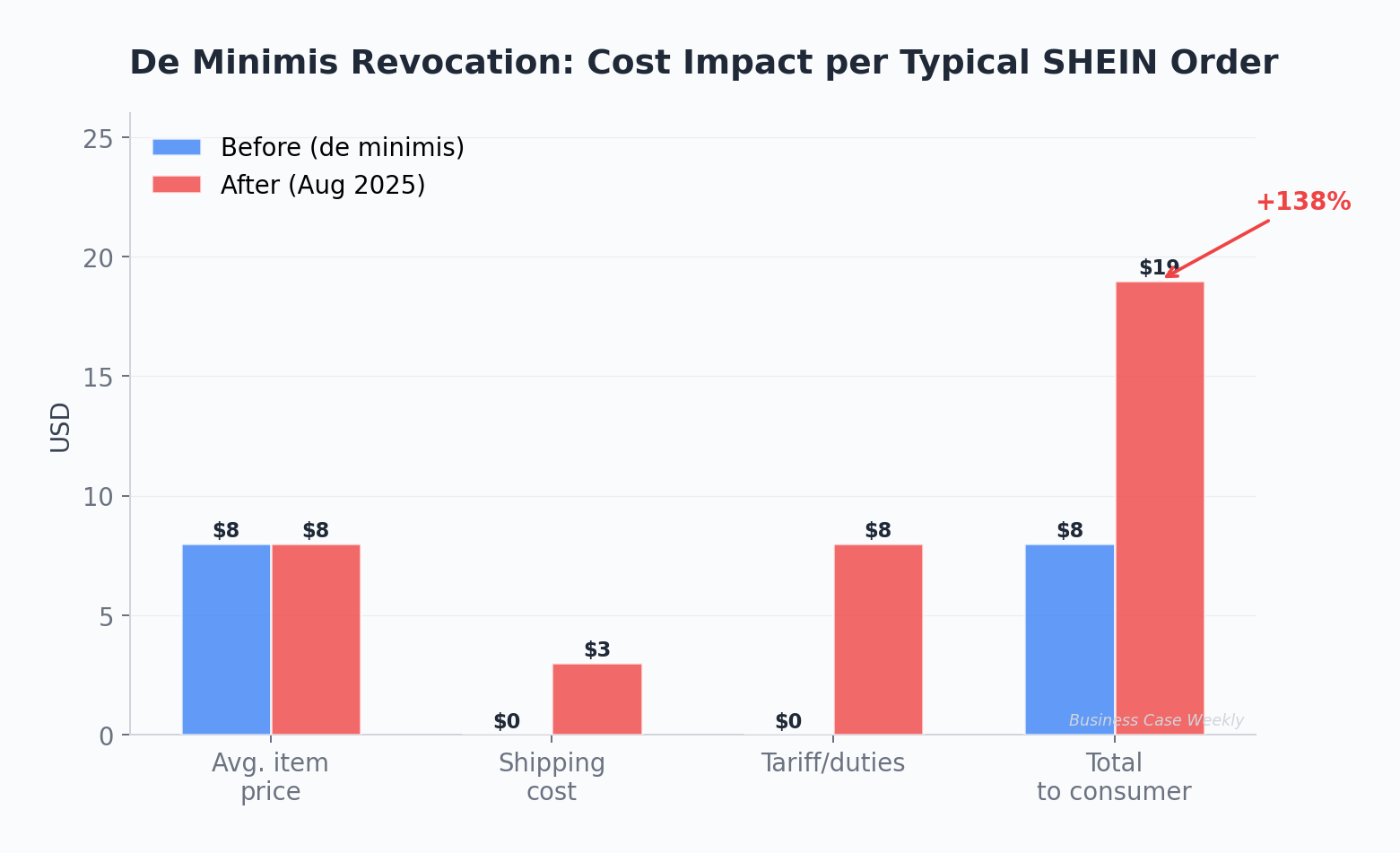
Timeline of De Minimis Revocation
In 2016, the US raised the de minimis threshold from $200 to $800. This enabled Shein and Temu’s direct-to-consumer model.
In FY2024, 1.36 billion packages entered the US under the de minimis provision, with the majority coming from China and Hong Kong.
On April 2, 2025, Trump signed an executive order revoking de minimis treatment for China and Hong Kong. The change became effective on May 2, 2025.
On April 25, 2025, SHEIN and Temu announced US price increases. This was the first visible consumer-facing impact.
On May 2, 2025, de minimis treatment ended for China-origin goods. Tariffs of 120% or $100 per package began to apply.
On July 30, 2025, Trump extended the revocation to all countries, blocking workarounds through places like Vietnam and Mexico.
On August 29, 2025, the global de minimis exemption ended. From that point on, all imports valued below $800 became subject to duties.
Impact
SHEIN’s response strategy:
Price increases: Average US prices rose 25-40% starting April 2025
Bulk shipping: Secured 100,000+ sqm Vietnam warehouse; bulk-shipping to US distribution centers
Marketplace acceleration: Onboarding US-based sellers whose products avoid China-origin tariffs
Geographic diversification: Accelerating growth in Middle East, LatAm, Southeast Asia
9. Funding History and Capital Structure
10. Where SHEIN Goes From Here?
Bull Case ($50B+ valuation, 2027)
Hong Kong IPO proceeds at $50B in H2 2026 or early 2027
US tariff regime stabilizes; SHEIN’s warehouse model absorbs costs
Asia-Pacific and Middle East growth offsets US deceleration
Revenue hits $70B+ by 2027; margins stabilize at 3-4%
IP litigation settles in bulk; governance reforms satisfy institutional investors
Base Case ($30B valuation, 2027)
Hong Kong IPO at $30B in late 2026
US business structurally impaired (–15-20% from peak)
Global revenue of $55-60B by 2027 with 2-3% margins
Ongoing regulatory friction in EU and US
SHEIN remains the #1 online fashion platform but growth normalizes to 10-15% annually
Bear Case (<$20B, no IPO)
CSRC blocks Hong Kong listing; no viable exchange accepts SHEIN
US tariffs + EU regulation shrink Western revenue by 30%+
Temu + TikTok Shopping erode market share in key segments
IP lawsuits result in material damages or injunctions
Valuation drops below $20B; early investors push for strategic alternatives
Citations
[1] “Shein’s Secret Architect: Xu Yangtian and His Unseen Influence,” Modaes Global, January 2026. https://www.modaes.com/global/back-stage/who-is-xu-yangtian-the-invisible-founder-of-shein
[2] “Shein,” Wikipedia, accessed March 2026. https://en.wikipedia.org/wiki/Shein
[3] “A Brief History of SHEIN,” Future Startup, November 2023. https://futurestartup.com/2023/11/06/a-brief-history-of-shein/
[4] “Chris Xu (entrepreneur),” Wikipedia, accessed March 2026. https://en.wikipedia.org/wiki/Chris_Xu_(entrepreneur)
[5] Chris Xu profile, Grizzly Bulls Billionaire Index. https://grizzlybulls.com/billionaires/sky-xu
[6] “The Success Story of Chris Xu: The Mastermind Behind Shein,” HulkApps, July 2024. https://www.hulkapps.com/blogs/ecommerce-hub/the-success-story-of-chris-xu-the-mastermind-behind-shein
[7] “The Enigma of SHEIN: Unraveling the Success of the Mysterious Online Retailer,” Benelux Chamber of Commerce in Shanghai. https://shanghai.bencham.org/news/enigma-shein-unraveling-success-mysterious-online-retailer
[8] Donald Tang, Interview with TIME, “A Top Shein Exec on That Influencer Trip Fiasco,” July 2023. https://time.com/6294934/shein-donald-tang-interview/
[9] “A Brief History of SHEIN,” Future Startup, November 2023. https://futurestartup.com/2023/11/06/a-brief-history-of-shein/
[10] “The Enigma of SHEIN,” Benelux Chamber of Commerce in Shanghai. https://shanghai.bencham.org/news/enigma-shein-unraveling-success-mysterious-online-retailer
[11] “Shein,” Wikipedia. https://en.wikipedia.org/wiki/Shein
[12] “Shein,” Wikipedia. https://en.wikipedia.org/wiki/Shein
[13] “5 Ways Shein Ecommerce is Leading the Evolution of Fast Fashion,” Monetate, October 2025. https://monetate.com/resource/5-ways-shein-ecommerce-is-leading-the-evolution-of-fast-fashion/
[14] “How Shein Built a Real-Time Supply Chain That Traditional Retail Can’t Match,” The Logistics Navigators, April 2025. https://www.logisticsnavigators.com/businessbreakdowns/sheins-supply-chain-how-real-time-logistics-beat-traditional-fast-fashion
[15] “5 Ways Shein Ecommerce is Leading the Evolution of Fast Fashion,” Monetate, October 2025. https://monetate.com/resource/5-ways-shein-ecommerce-is-leading-the-evolution-of-fast-fashion/
[16] “SHEIN Is Meeting Customers’ Demands Through Reimagining the Supply Chain,” WWD, June 2023. https://wwd.com/business-news/business-features/shein-meeting-customers-demands-through-reimagining-supply-chain-1235688849/
[17] “Donald Tang: How SHEIN Got So Big So Fast,” 20VC podcast summary, September 2024. https://www.getrecall.ai/summary/e-commerce/donald-tang-how-shein-got-so-big-so-fast-the-fastest-growing-company-in-history-or-e1208
[18] “Shein’s Donald Tang: We are not fast fashion but fashion on-demand,” CNBC, January 2025. https://www.cnbc.com/video/2025/01/23/sheins-donald-tang-we-are-not-fast-fashion-but-fashion-on-demand.html
[19] “Inditex’s AI Strategy: Analysis of Dominance in New Era of Fashion,” Klover.ai, July 2025. https://www.klover.ai/inditex-ai-strategy-analysis-of-dominance-in-new-era-fashion/
[20] “How Shein Built a Real-Time Supply Chain,” The Logistics Navigators, April 2025. https://www.logisticsnavigators.com/businessbreakdowns/sheins-supply-chain-how-real-time-logistics-beat-traditional-fast-fashion
[21] “Unraveling Shein’s Supply Chain: Foundation, Reshoring, and Controversy,” Gadallon Substack, June 2023. https://gadallon.substack.com/p/unraveling-sheins-supply-chain-foundation
[22] “Shein,” Wikipedia. https://en.wikipedia.org/wiki/Shein
[23] “Shein Revenue and Usage Statistics (2026),” Business of Apps, January 2026. https://www.businessofapps.com/data/shein-statistics/
[24] “SHEIN Is Meeting Customers’ Demands Through Reimagining the Supply Chain,” WWD, June 2023. https://wwd.com/business-news/business-features/shein-meeting-customers-demands-through-reimagining-supply-chain-1235688849/
[25] “Shein Revenue, Growth, Usage and Download Statistics for 2024,” Mobiloud, July 2025. https://www.mobiloud.com/blog/shein-statistics
[26] “Shein Revenue and Usage Statistics (2026),” Business of Apps, January 2026. https://www.businessofapps.com/data/shein-statistics/
[27] “Shein takes step toward its IPO,” Axios, July 2025. https://www.axios.com/2025/07/08/shein-ipo-london-hong-kong-china
[28] “Report: SHEIN Business Breakdown & Founding Story,” Contrary Research, November 2023. https://research.contrary.com/company/shein
[29] “Shein,” Wikipedia. https://en.wikipedia.org/wiki/Shein
[30] Donald Tang, Interview with TIME, July 2023. https://time.com/6294934/shein-donald-tang-interview/
[31] “What to Know About the Shein Lawsuit,” TIME, July 2023. https://time.com/6295035/shein-lawsuit-copyright-infringement/
[32] “Shein violated the RICO Act by stealing people’s designs, a lawsuit says,” NPR, July 2023. https://www.npr.org/2023/07/15/1187852963/shein-rico-racketeering-lawsuit
[33] “Shein will continue to face RICO charges in copyright infringement lawsuit,” Fashion Dive, November 2024. https://www.fashiondive.com/news/shein-rico-copyright-infringement-lawsuit/732787/
[34] Brett Lewis quoted in “Fashion giant Shein has been slapped with yet another lawsuit,” Fortune, April 2024. https://fortune.com/2024/04/16/shein-class-action-lawsuit-copyright-infringement-data-scraping-ai-art-alan-giana-china/
[35] “Shein Revenue and Usage Statistics (2026),” Business of Apps, January 2026. https://www.businessofapps.com/data/shein-statistics/
[36] “Shein Statistics 2026: Net Worth, Revenue & SWOT Analysis,” GrabOn, January 2026. https://grabon.com/blog/shein-statistics/
[37] “Shein’s embattled IPO signals mounting troubles for fast fashion giant,” CNBC, May 2025. https://www.cnbc.com/2025/05/30/sheins-embattled-ipo-signals-mounting-troubles-for-fast-fashion-giant.html
[38] “Shein files for Hong Kong IPO amid London delays,” PitchBook, July 2025. https://pitchbook.com/news/articles/shein-files-for-hong-kong-ipo-amid-london-delays
[39] “Shein struggles to move IPO forward amid broader growth challenges,” eMarketer, January 2025. https://www.emarketer.com/content/shein-growth-challenges-ipo-uk
[40] “The Trials of 2025: Shein’s Pivotal Year in the Fashion Industry,” Modaes Global, December 2025. https://www.modaes.com/global/companies/2025-the-year-of-sheins-way-of-the-cross
[41] “Shein files for Hong Kong IPO in hopes of salvaging London listing: FT report,” CNBC, July 2025. https://www.cnbc.com/2025/07/08/shein-files-for-hong-kong-ipo-in-hopes-of-salvaging-london-listing-ft-report.html
[42] “Shein files for Hong Kong IPO amid London delays,” PitchBook, July 2025. https://pitchbook.com/news/articles/shein-files-for-hong-kong-ipo-amid-london-delays
[43] “Shein Is Said to Have Filed Confidentially for Hong Kong IPO,” Bloomberg, July 2025. https://www.bloomberg.com/news/articles/2025-07-11/shein-is-said-to-have-filed-confidentially-for-hong-kong-ipo
[44] “Shein Files for Hong Kong IPO as London Listing Remains Stalled,” Global Cosmetics News, July 2025. https://www.globalcosmeticsnews.com/shein-files-for-hong-kong-ipo-as-london-listing-remains-stalled/
[45] “SHEIN Ditches London IPO? Why the Fast Fashion Giant Is Now Eyeing Hong Kong Instead,” IBTimes UK, May 2025. https://www.ibtimes.co.uk/shein-ditches-london-ipo-why-fast-fashion-giant-now-eyeing-hong-kong-instead-1734482
[46] “Shein’s embattled IPO signals mounting troubles for fast fashion giant,” CNBC, May 2025. https://www.cnbc.com/2025/05/30/sheins-embattled-ipo-signals-mounting-troubles-for-fast-fashion-giant.html
[47] “Tariffs in the second Trump administration,” Wikipedia, accessed March 2026. https://en.wikipedia.org/wiki/Tariffs_in_the_second_Trump_administration
[48] “Temu and Shein face massive tariffs. But don’t count them out of the U.S. e-tail scene, experts say,” CNBC, May 2025. https://www.cnbc.com/2025/05/06/temu-shein-face-big-us-tariffs-dont-count-them-out-experts-say.html
[49] “Etsy, eBay, and Shein reel as ‘de minimis’ tariff exemption ends,” Fortune, August 2025. https://fortune.com/2025/08/29/etsy-ebay-shein-de-minimis-tariff-exemption-ends-adding-charges/
[50] “Shein and Temu to Raise U.S. Prices,” Global Training Center, April 2025. https://globaltrainingcenter.com/shein-and-temu-to-raise-u-s-prices-as-tariffs-and-de-minimis-exemption-end/
[51] “Shein and Temu to Raise U.S. Prices,” Global Training Center, April 2025. https://globaltrainingcenter.com/shein-and-temu-to-raise-u-s-prices-as-tariffs-and-de-minimis-exemption-end/
[52] “SHEIN Ditches London IPO?” IBTimes UK, May 2025. https://www.ibtimes.co.uk/shein-ditches-london-ipo-why-fast-fashion-giant-now-eyeing-hong-kong-instead-1734482
[53] “Presidential 2025 Tariff Actions: Timeline and Status,” Congress.gov. https://www.congress.gov/crs-product/R48549
[54] “Who is Donald Tang, the public face of Shein,” Business Insider, September 2024. https://translate.google.com/translate?u=https://www.businessinsider.com/who-is-donald-tang-shein-executive-chairman-2024-9
[55] “Shein Pledges China Supply Chain Investment to Woo Beijing,” Business of Fashion, February 2026. https://www.businessoffashion.com/news/china/shein-pledges-china-supply-chain-investment-to-woo-beijing/
[56] “Shein Pledges China Supply Chain Upgrade in Bid to Woo Beijing,” Bloomberg, February 2026. https://www.bloomberg.com/news/articles/2026-02-24/shein-pledges-china-supply-chain-upgrade-in-bid-to-woo-beijing
[57] “Elusive Shein boss hails Chinese roots in rare public appearance,” BBC via Yahoo Finance, February 2026. https://ca.finance.yahoo.com/news/elusive-shein-boss-hails-chinese-031820919.html
[58] “Shein pledges China supply chain upgrade in bid to woo Beijing,” FashionNetwork, February 2026. https://ww.fashionnetwork.com/news/Shein-pledges-china-supply-chain-upgrade-in-bid-to-woo-beijing,1809990.html
[59] “What’s Behind Shein’s $1.4B China Bet,” Yahoo Finance / Sourcing Journal, February 2026. https://finance.yahoo.com/news/behind-shein-1-4b-china-232158300.html
[60] “Hong Kong’s IPO Revival,” FT Locations, 2025. https://www.ftlocations.com/knowledge-hub/blog/hong-kongs-ipo-revival-companies-flocking-to-sehk
[61] “Report: SHEIN Business Breakdown & Founding Story,” Contrary Research, November 2023. https://research.contrary.com/company/shein
Excellent! It’s obvious that you put a lot of time and effort into this one.
rlly looking forward to read more like thattt